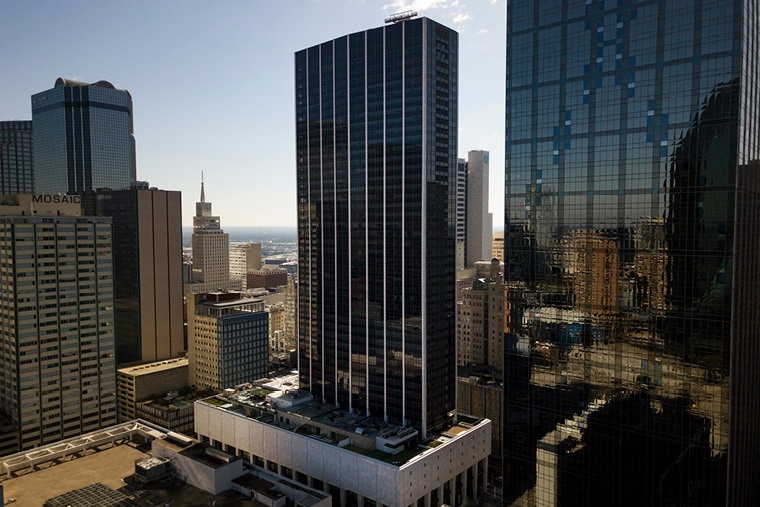
A 52-story bank tower that became a 219-room hotel, 324 apartments, and the largest historic tax credit project in Texas history — delivered through three ownership changes, a global pandemic, and one freight elevator.
Project Type
Adaptive Reuse / Historic Preservation
Location
1401 Elm Street, Downtown Dallas, TX
Original Structure
First National Bank Tower (52 stories)
Total Value
~$450M
Square Footage
~1M SF
Program
219-room Thompson Hotel + 324 apartments + restaurant/retail
Historic Tax Credits
$100M — largest in Texas history
Workforce
500 workers per day at peak
Project Manager
Brian Wileman, Senior PM (21 years at ANDRES)
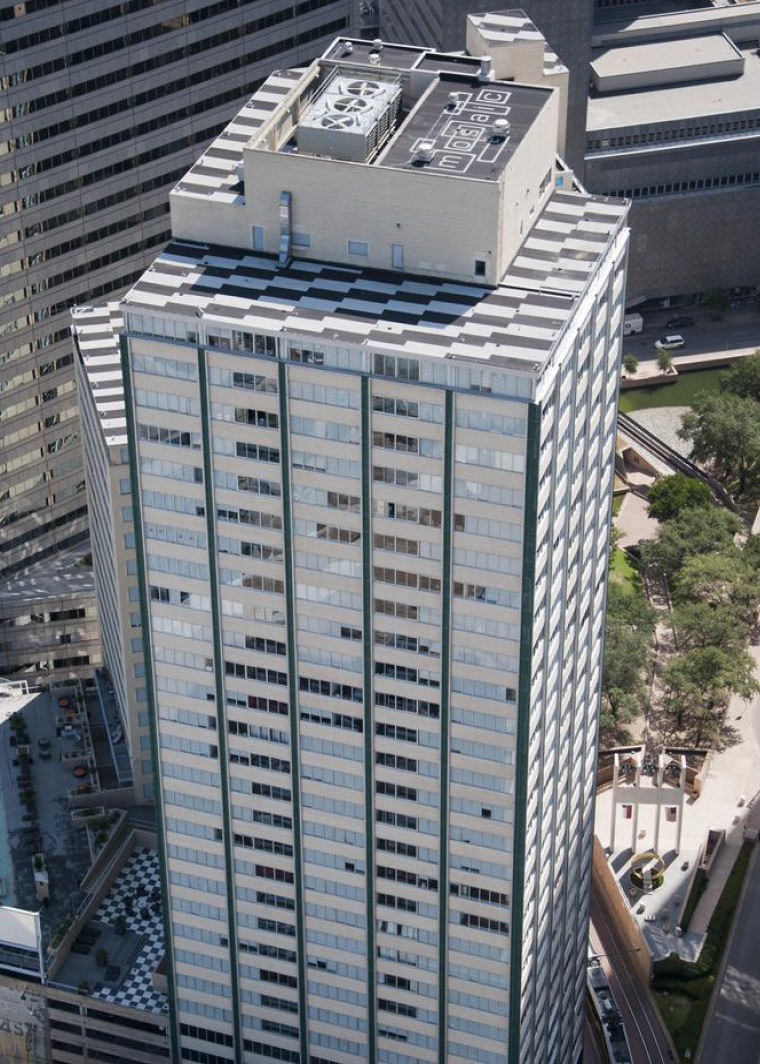
First National Bank Tower was dead. A 52-story monument to a financial era nobody remembered, sitting vacant in downtown Dallas. The plan — convert it into a Thompson Hotel, 324 apartments, street-level restaurant and retail — was ambitious enough to qualify as delusional. A million square feet. $100 million in historic tax credits from the National Park Service and Texas Historical Commission, which meant every fixture, every panel, every elevator surround had to be preserved or documented.
That was the plan on paper. What actually happened was worse.
Ownership changed three times during the project. Three different groups with three different priorities, three different budgets, three different ideas about what this building was supposed to become.
Each transition meant the same thing: a new team walking onto a project they didn't design, on a schedule already in motion, in a building they'd never set foot in. And each time, the same question — who knows what's been built, what's in progress, and what's left?
ANDRES did. Same PM. Same superintendent. Same field team. Not a binder on a shelf — the actual people who'd been solving problems inside that tower since day one.
That's what continuity produces when it's real. Not loyalty as a talking point. A structural advantage.
Temperature checks. Quarantine protocols. Crew splitting. Every constraint the project already carried — and there were plenty — got layered with new ones that didn't exist when the contract was signed.
The financing deadlines tied to tax credits and TIF agreements didn't care about a virus. Those dates didn't move. ANDRES absorbed the protocols, restructured crew sequencing, and kept building.
Complexity Highlights
ONE ELEVATOR. FIFTY-TWO FLOORS.
The building's original passenger elevators were clad in historic glass. The Texas Historical Commission and National Park Service wouldn't allow replacements — modern glass was a visible color and texture mismatch against the original facade. Existing code let the non-compliant glass stay. New code would've required tempered and insulated replacements. So touching the passenger elevators meant triggering a code upgrade nobody could afford.
One freight elevator. That's it. The sole construction lifeline for a 52-story tower.
Every sheet of sheetrock. Every tool. Every piece of finish material. Through that single shaft. Eighty thousand sheets of sheetrock over the life of the project.
500 WORKERS ON 50 FLOORS — THROUGH ONE SHAFT
At peak, 500 workers occupied the building. Roughly 10 per floor across 50 active floors. With one freight elevator, conventional construction logistics would've collapsed before lunch on day one.
So ANDRES built new logistics from scratch: staggered start and end times to prevent elevator bottlenecks. Bathrooms on every other floor — workers walk one flight instead of riding the elevator. Workers brought lunch and stayed on their assigned floor for full 10-12 hour shifts. Material deliveries scheduled to the hour, not the day.
The building didn't run on construction norms. It ran on a protocol designed for one constraint that touched everything.
$100M IN TAX CREDITS MEANS ZERO ROOM FOR ERROR
Carlos Trevino walked all 52 floors before construction started, cataloging elevator fixtures, paneling, and architectural details so the team could plan demolition and construction around elements that could not be disturbed. That inventory became the baseline for every preservation decision — and the documentation that protected $100 million in credits.
Team Continuity
THE KNOWLEDGE
NEVER LEFT
THE BUILDING.
Brian Wileman managed this project for its entire duration. Three ownership transitions, a pandemic, logistics unlike anything else in Dallas. He didn't rotate off after a phase. He didn't get reassigned when the second group showed up. The knowledge he built on floors 1 through 52 stayed on floors 1 through 52.
When Brian moved to Knox Street — the $619M mixed-use JV with Balfour Beatty — he carried every lesson with him. The discipline required to move 80,000 sheets of sheetrock through one elevator now informs how he sequences material on a 29-story tower with 46 custom condos.
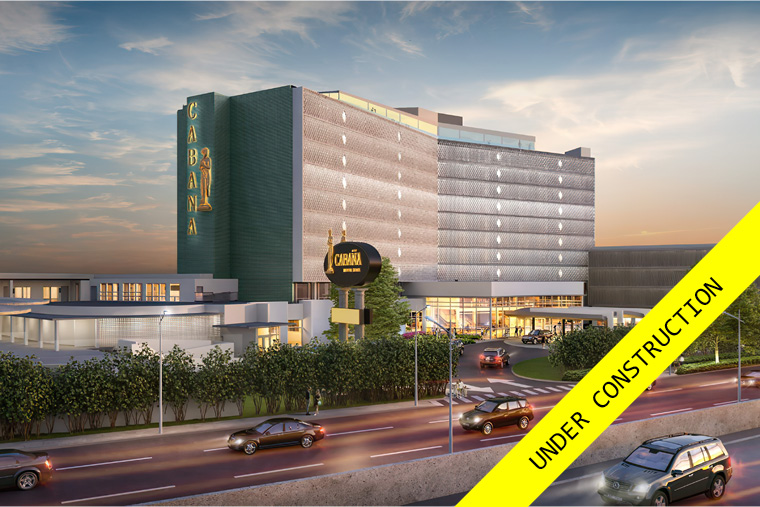
Carlos Trevino — the guy who inventoried every historic element during preconstruction — is now Senior PM on the Cabana, another adaptive reuse project in the Dallas Design District. The National didn't just produce a building. It produced institutional knowledge that shows up on every ANDRES project that follows.
2021
ENR TX/LA Renovation/Restoration Award of Merit
2022
TEXO Distinguished Historic Renovation
Building something this complex starts with a conversation.
Talk to the team that delivered 52 stories through three ownership changes.