595,000 units short. That’s the national senior housing gap right now. The oldest Boomers turned 80 this year, and the construction pipeline hasn’t caught up. Not even close.
But here’s the problem most developers run into: the contractors who know multifamily don’t understand senior living regulations. And the ones who claim senior living expertise can’t build at scale.
ANDRES does both. Has for three decades. BD+C ranks us #21 nationally in Senior Living. TEXO gave Touchmark at Emerald Lake its Hall of Fame award in 2024 — the highest project honor they hand out. That didn’t happen because we checked boxes. It happened because the team that built it had been doing this work together for 20 years.
#21
BD+C Senior Living Nationally
595K
Unit National Shortfall
30+
Years in Senior Living
68%
Industry Annual Turnover
Senior living construction is multifamily construction with consequences.
Independent living, assisted living, skilled nursing, memory care — each one has different code requirements, different finish standards, different mechanical systems, different operational flows. And in a CCRC, you’re building all of them in the same structure. Connected. Interdependent. One mistake in the memory care wing’s air handling affects the independent living corridor three floors up.
The mechanical systems alone would give most multifamily contractors pause. Medical-grade air handling. Emergency power. Nurse call integration. Environmental controls that have to work — not “work well enough,” but work — because the people living there can’t just open a window and deal with it.
We don’t treat senior living as a specialty add-on. It’s where our multifamily DNA meets the regulatory depth these buildings demand. Same structural systems. Same construction management. Same people. Different stakes.
This is the part nobody talks about in the pitch.
Senior living projects run 18 to 30 months. And during that time, you’re often building next to — or inside — a campus where elderly residents are living their daily lives. Eating meals. Getting care. Sleeping.
Noise mitigation. Vibration control. Maintained access paths for residents who use walkers or wheelchairs. Coordination with facility ops teams who are managing medication schedules while you’re running concrete trucks 200 feet away.
These aren’t change-order items. They’re baseline.
Jeff Kempf (28 years), Jonathan Haywood (25 years), Randy Bessire (25+ years) — they’ve built senior living across Texas for decades. The protocols aren’t written in a manual. They’re written into how these guys plan a project from day one. Fewer surprises for the operator. Fewer disruptions for residents. Fewer coordination failures between your care staff and our construction team.
Construction turns over 68% of its workforce every year. In senior living — where the learning curve is steep, the regulatory requirements are specific, and the project timelines stretch past two years — that turnover is devastating.
The PM who learned Presbyterian Village North’s operational constraints? Same PM available for your project. No ramp-up. No re-learning. No risk of a green team making a mistake a tenured team would catch before it happened.
Employee ownership is why they stay. Not as a badge. As the mechanism that makes it economically irrational to leave. What you actually need from that retention is what they’ve accumulated: pattern recognition you can’t hire off the street or train in a classroom.
The United States faces a 595,000-unit shortfall in senior housing. That number is impossible to ignore.
The demographic wave that will drive demand for the next two decades has already arrived. In Texas, it’s amplified — retirees relocating from higher-cost states, aging-in-place residents whose homes no longer work, families looking for proximity to care for their parents. DFW, Houston, Austin, San Antonio. Every major metro is short on inventory.
Capital markets have responded. Senior living development is attracting institutional investment at levels not seen since before the pandemic. Operators who paused during COVID are reactivating. New operators are entering Texas.
What hasn’t kept pace is contractor capacity. You need regulatory knowledge, operational sensitivity, and the ability to deliver complex mixed-acuity buildings on tight timelines. The contractors who have that depth are the ones who will build the next decade’s supply. The rest will learn on the job — at the operator’s expense.
Portfolio
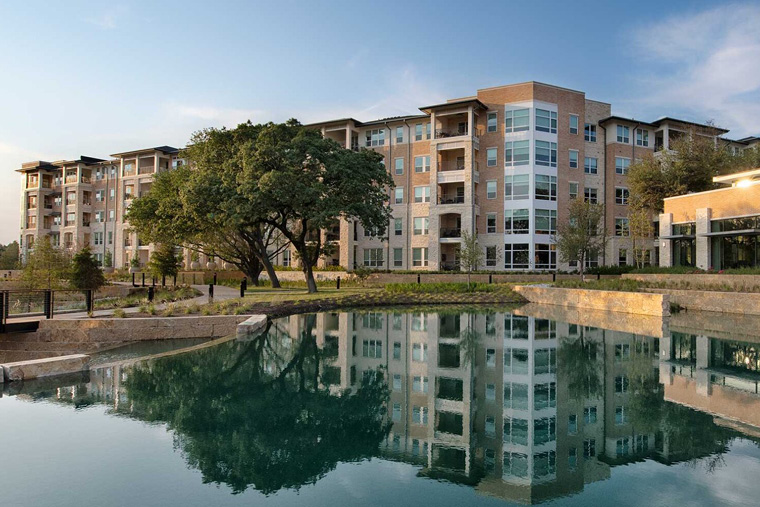
Touchmark at Emerald Lake
Boise, ID
TEXO Hall of Fame Award 2024. Large-scale CCRC with independent living, assisted living, and memory care. The Hall of Fame is TEXO’s highest project honor — recognition of both construction quality and project management across the full delivery lifecycle.
Presbyterian Village North
Dallas, TX
TEXO Distinguished Interior Award 2023. Major renovation and expansion of an established CCRC serving the North Dallas community. Interior work required maintaining operational continuity for existing residents while delivering new spaces that meet current design and code standards.
Vivante Turtle Creek
Dallas, TX
$158M. Currently in construction. Luxury senior living community in one of Dallas’s most desirable neighborhoods.
The Stayton
Fort Worth, TX
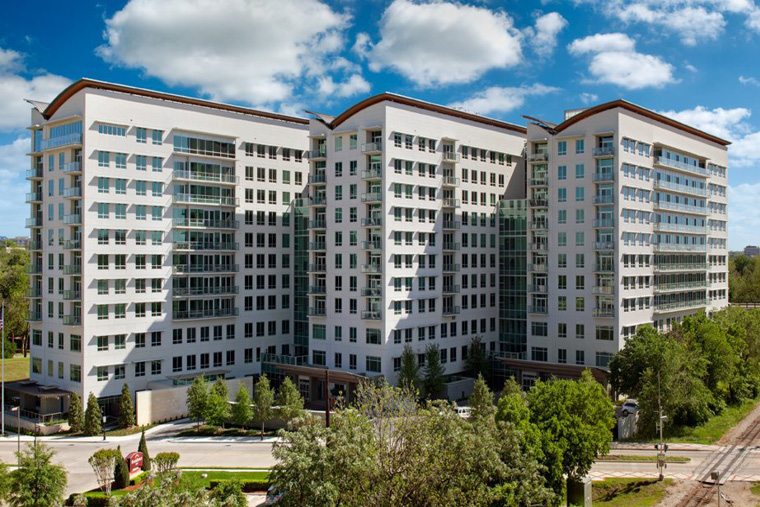
800,000 SF. Three interconnected 11-story towers over 2 levels of below-grade parking. 188 independent living units, 41 assisted living, 41 skilled nursing, memory support wing, indoor pool, multiple dining venues. Completed in 20 months on an aggressive schedule. 5-star resort-style finishes. This is what CCRC complexity actually looks like.
Edgemere CCRC
Dallas, TX
Edgemere and Northwest Highway. ANDRES has built on this site three times: the original facility, a large expansion, and modifications to existing common spaces. Three engagements on the same campus over multiple decades. That doesn’t happen unless the operator trusts the builder.
Legacy at Willow Bend CCRC
Plano, TX
Continuing Care Retirement Community in Plano’s Legacy corridor. Part of ANDRES’s sustained senior living presence in Collin County.
Mirador CCRC
Corpus Christi, TX
Continuing Care Retirement Community serving the Coastal Bend region. Senior living delivery outside DFW.
The Buckingham CCRC
Houston, TX
Continuing Care Retirement Community in Houston. Part of ANDRES’s multi-market senior living portfolio.
Village of Preston Hollow Retirement
Dallas, TX
Retirement community in the Preston Hollow neighborhood. Long-standing presence in senior living across Dallas.
People Also Ask
What is a CCRC and why is it so complex to build?
A CCRC combines independent living, assisted living, skilled nursing, and memory care on one campus. Each care level has different building codes, different finish standards, different mechanical systems, different operational flows. You’re effectively building four different building types as a single interconnected facility. The construction team has to understand not just how to build each piece, but how they connect — physically, mechanically, and operationally. It’s the most complex residential building type in construction.
How does ANDRES manage construction next to occupied senior living facilities?
Detailed planning and constant communication with facility operations. Noise and vibration controls that go beyond standard practices. Maintained access paths for residents with mobility limitations. Coordination with care staff on daily schedules and emergency protocols. Contingency planning for weather or construction events that could affect resident safety. Our team has done this across multiple facilities — the protocols are embedded in how we plan these projects.
What makes senior living construction different from standard multifamily?
Three things. The regulatory environment is more demanding — life safety systems, accessibility standards, medical-grade MEP requirements, and licensing-related construction standards. The building program is more varied — residential units, dining venues, wellness centers, clinical spaces, and memory care environments, all under one roof. And the occupants are more vulnerable — construction decisions directly affect the health and safety of elderly residents in adjacent buildings.
Does ANDRES build hospitals or healthcare facilities?
No. ANDRES specializes in senior living residential construction — CCRCs, independent living, assisted living, and memory care communities. Our work is in the residential and hospitality end of the senior care spectrum, not acute-care hospital or clinical facility construction.
How long does a senior living project typically take?
Depends on scale and complexity. The Stayton — 800,000 SF with three 11-story towers — was completed in 20 months on an aggressive schedule. A typical CCRC runs 18 to 30 months depending on scope, whether it’s new construction or renovation, and whether the project is phased to keep adjacent buildings operational.
Why is team retention important in senior living construction?
Because the learning curve is steep and the consequences of inexperience are real. Regulatory requirements differ from standard residential. You’re coordinating with facility operations teams. Managing construction adjacent to vulnerable populations. Delivering buildings where each wing has different specs. A team that’s done this carries all of that forward. A new team learns it on the job — at the operator’s expense and the residents’ risk.
The residents deserve a builder who’s done this before.
Senior living isn’t a building type you figure out on the fly. If you’re planning a CCRC, an assisted living community, or an independent living expansion — let’s talk about the team that would run it. In this sector, the team is the capability.